Tuesday, 7 April 2015

Francisco Goya's etchings' exhibition at Torreão Poente , Lisboa (cont.)


(...)


They spin finely. The devil himself wouldn't be able to undo the thread.


She was sensitive (left) - What else could it have been. Life has its ups and downs and her life couldn't have ended any other way. It is nicely stretched (right) - Oh Auntie is no fool! She knows how important it is to have one's stocking stretched adequately.


For Count Palatine (left) - In every field of science there are charlatans, who despite not having studied seem to know everything and find remedy for just anything. One shouldn't trust their words. A true wise man doubts his own success - he promises little and achieves a lot. Count Palatine belongs to those who don't even keep his promises. Poor unfortunate girls (right) - Those who have been unfortunate enough to have become prostitutes are taken to jail. The ones in higher social ranks live as they please. Laws seem to have only been made for the poor.


Specks of dust (left) A woman of honour who so diligently served everybody shouldn't be treated like that. Nothing could be done about it (right) - This saintly lady was persecuted to death and paraded triumphantly. If their idea was to offend her, it has been a waste of time, for nobody can shame those whose acts are shameless.


Use one's head (left)  - The best way for simple-headed girls to achieve poise is by using their heads. Over the top (right) - The son has been mischievous and his mother has been bad-tempered. There are parents who beat their children up till they are black and blue for having done a minor thing like breaking a pot and yet don't punish them for major mistakes.


Who's touched by who? (left) - When an empty-headed man tries to catch a woman's attention he uses every possible facial expression (Duchesse of Alba and Goya). Hush (right) - Distinguished ladies take advantage of  old women standing outside chuchyards praying to hand out love messages to their lovers.


Why hide it? (left) - The answer is simple, he does not want to spend it. Despite being 80 years old he may still be able to live on for a d further month. Fearing having more than a life time to spend his money one, his gesture is sometimes interpreted as avarice. She prays for her (right) - May God bestow good fortune upon her and keep her away from evil, men with university degrees and/or Lwa ranking officers.


Monday, 6 April 2015

The latest films I have watched ...


I have always been an avid reader of books on the Nazi occupation, especially those which despite being "dificult" to digest due to the unspeakable gruesome actions that were carried out have somehow always highlighted a certain sense of loyalty, friendship, solidarity and whichever values one might refer to despite the hard circumstances.
 
 
I have had the opportunity of watching two films in the last two weekends, which are both based on books, which in turn were based on real life stories that happened during that period of war.


Based on Uri Orlev's true story "Run, boy, run" takes us through the saga of an 8 year-old boy cast adrift in Nazi occupied Poland. The film strongly reflects on a kid's struggle to survive, as an oath made to his father the day his father distracted some Nazi soldiers and got killed to allow his child to run away without being caught, but also people's efforts to maintain a certain degree of loyalty despite being temporarily forced to concealing it.


"Suite Francaise" on the other hand is based on a fragment of the Ukrainian-Jewish writer Irene Némiovski's novel of the same name centring it on a romance between a French villager  and a German officer during the early years of the German occupation of France in what turned out to be a rather complicated sequence of events, where loyalty was called  forth.


I feel they are both worth being watched not just because of what one may further ponder on but also because they have been brilliantly interpreted.


Francisco Goya's etchings exhibition at Torreão Poente, Lisboa (still)


(...)

The etchings were fairly small and therefore difficult to photograph, especially because no flash was allowed but I kept on photographing the ones I found to be rather satirical and perfectly identifiable in nowaday's life, as I wondered about Goya's risk taking at having exposed his "audacity" at such an epoch.


Everyone falls ... a warning to consider those who have "fallen" before.


It is time (left) - Witches, hobgoblins, specters and phantoms avoid being seen (they are known to come out in the dark). The "Chinchilas" (right) -  He who hears nothing and knows nothing belongs the the numerous family of "Chinchillas". 


You will not escape (left) - She who wants to be caught will never escape. Nobody has seen us (right) - Who cares if priest often go down to the cellar?


When day breaks off we go (left). Devout profession (right) Do you swear to obbey and respect your masters? Well then you are a witch now.


What a fine master! (left) - Brooms are very important utensils. Blows (right) - "There has been a great catch of children the previous night. The banquet will be a good one. Bon appétit".


Rehearsal (left) - Little by little she is making progress. There she goes (right) There goes a witch riding on a physically impaired devil.


Who would have believed it! (left) Friendship is the daughter of virtue; villains may become accomplices but never friends. Look at the solemnity of the act (right).


Whistle blowing sorcerers (left) - Considered the laziest and less skilled in the witchcraft world. Correction (right) - No progress can be made without it.


There is a lot to profit from - Those who live to be 80 take advantage of their children and those who are not yet 18 take advantage of the grown-ups.


Bravo! (left). No more, no less (right)


Could the pupil eventually know more than the teacher?


(To be continued)


Sunday, 5 April 2015

Francisco Goya's etchings exhibition - Los Caprichos at Torreão Poente, Lisboa as part of the UNESCO promoted Dancing project for Millennium goals


I 've been to Francisco Goya's etchings exhibition at Torreão Poente, which I felt to be a unique opportunity to see the painter's satirical approach to the late 18th century Spanish nobility and clergy. The exhibit was divided into several themes, though one initial part highlighted the behavioural attitudes of Goya's fellow countrymen, whilst the other focused on the absurd depicting delirious visions and fantastic scenes with strange creatures.
 
The additional information provided underneath each etching was  very helpful so as to allow the visitors to fully understand what each one was about, once there were details one might not either notice immediately or find out a plausible explanation for. I ended up photographing many of the 80 being in display, which I looked at as a sequence of story telling images.


Yes, they say and they offer their hand to the first comer - The young woman wearing a black mask (revealing her character rather than concealing her facial features)  is seen giving her left hand to her future husband in what seems to have been a decision based on lust. A mutual mistake, as according to the man's wicked gaze there seems  to be a thought mostly associated to what he can gain with the marriage.


Here comes the bogey-man. According to Goya parents who scared their children with stories of ghosts, imaginary creatures and absurd superstitions, which would naturally accompany them throughout their lives, had to be enlightened so as to change that type of educational pattern and thus bring superstition to an end.


Two of a kind. Following a dispute on whether  men are better or  worse than women, vices of both genders according to Goya stem from a bad upbringing. The  young lady is depicted as not too different from the one who is entertaining her. As for the two old women behind, one is just as vile as the other.


Nobody gets to know one another. The world seen as a masquerade, where the facial features, the apparel and even the voices of people are disguised. Everyone seems to want to show something they are not.


Even so he cannot really get through to her. How can he? To make out what she is like a monocle is not enough - one needs discernment and a certain degree of knowledge as to what the world is like, which is what the depicted gentleman doesn't seem to have.


She was taken. The woman who isn't on guard will be possessed by the first man who grabs her.


Tantalus. If he were more gallant and less boring she would come back to life.


Love and Death. Here on can see one of Calderon's lovers. Being unable to win over his competitor he dies in the arms of his beloved, thus losing her because of his imprudence.
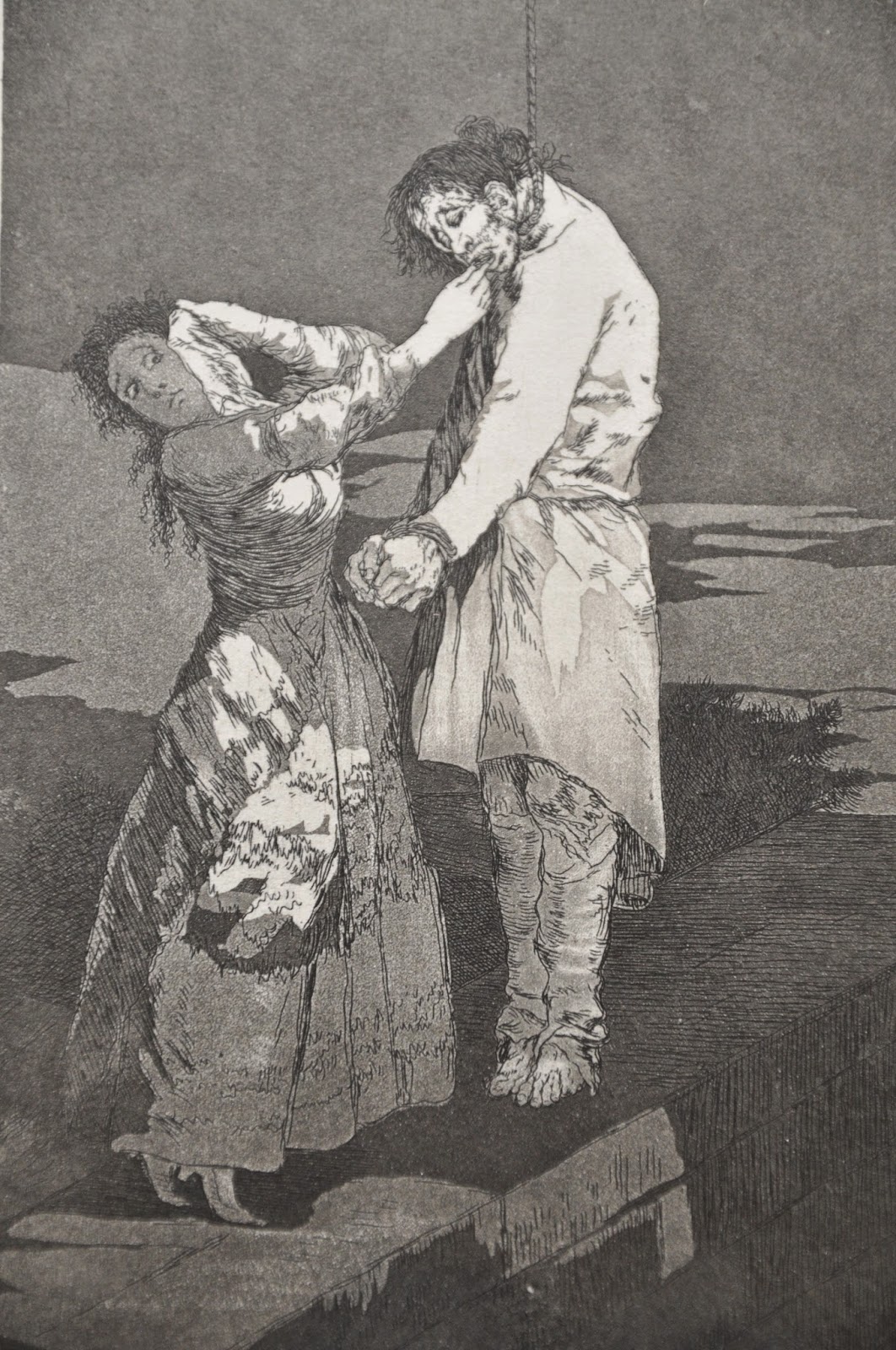


Out hunting for teeth. The teeth of hanged men were very effective on spell making. Without them nothing seemed to work out. According to Goya it was a shame to continue believing in such a nonsense.


What a sacrifice! How can it be with the groom not being very good-looking (yet rich). At the expense of one unhappy forever girl one hungry family will be rescued.


May God forgive her. Having left her hometown the young lady went to Madrid where she won the lottery. Down in Prado she comes across a beggar whom she refused to give money to until she recognised her mother under the filthy clothes she was wearing.


A gift for the master. They would be considered ungrateful pupils if they didn't visit their former teachers to whom they owe it all.


(To be continued)