Tuesday, 17 June 2014

The 6 day trip to Ireland - Dublin (Day 2 - morning - cont.) - Around the Castle area - Dublin Castle and the Chester Beatty Library Galleries - The 11th of June 2014


(...)

We then headed towards the Castle area along the Aston and Wellington quays having turned into Parliament street  where a rather interesting building on the right hand side caught my attention (I would later go back to photograph its decorated façade). A little bit further up the street stood a domed building supported by twelve columns - the Dublin Town Hall, another remarkable example of 18th century architecture in the city


Our intention was not to visit the Castle of Dublin, which we would try to go back to some days later, but the Chester Beatty Library galleries instead, though I couldn't resist taking a few photographs of its façade and some of its small details.


Prior to walking into the exhibition galleries we strolled around the Garda Memorial garden within the Castle premises. According to what I read the principal concept behind the design of the memorial garden was the way sudden unexpected death brings an abrupt end to the natural cycle of life. 


The Chester Beatty Library definitely opens a window on the artistic treasures of great cultures and religions of the world. The rich collection of manuscripts, prints, icons, miniature paintings, early printed books and objects of Art from countries across Asia, the Middle East, North Africa and Europe we had access to as a result of the collecting activities of Chester Beatty was indescribable.

The diversity of the collection the former American mining magnate assembled captures  much of the richness of human creative expression from about 2700 BC to the present day. The highlights of the collection are said to be beautifully illuminated  copies of the Qur'an, the Bible and several medieval manuscripts.

We could have easily spent the whole day in the main exhibition galleries (The Arts of the Book on the first floor and The Sacred Traditions on the second floor) had we had the time. Photographing was not allowed and once we walked into the Library bookshop I felt like buying most of the reproductions and books related to what I had just seen.


Christ in glory with Donors - Armenian Gospel book c.1615 (left). Hafvad's daughter finds a worm in an apple, from a copy of Firdawsi's Shahnama (Book of Kings) AD 1341 (right).


Painted scrolls of a Waka Poetry Contest depicting Twelve Kinds of Beasts and Birds  - Mid 17th century, Edo period, Japan (left).St Michael vanquishing the Devil - Gothic bookhand on vellum, 1408, Paris (right)


As I reluctantly walked back into the crowded streets arond the castle I wondered how difficult it might have been to have had the privilege of seeing such  priceless collection had Sir Chester Beatty  decided not to move to Ireland in the 50's.  


The bustle of the side streets brought me back to the Irish "reality" ... the reality of the old "blending" with the modern ... brightly coloured pubs standing against old charmful buildings ...


A colourful sequence of Fridas and two rather different painted versions representing the Beatles caught my attention as I made my way towards the Trinity College.


(To be continued)

The 6 day trip to Ireland - Dublin (Day 2 - morning) - The Customs House and the Famine Memorial - The 11th of June 2014


As my daughter and I were going out of Dublin the following day we decided to take advantage of the second day in the capital city and try to see as much as we could.


After having had a copious Irish breakfast we set off in the direction of the river Liffey's north bank to see the 18th century Customs House. As we were walking along Beresford Place we came across a statue of  representing James Connolly, an Irish Republican and socialist leader who was executed by a British firing squad because of his leadership role in the Easter Rising in 1916.


The four façades of the Neo-Classical building of the Customs House were richly adorned with sculpted keystones symbolising the rivers of Ireland as well as the Coats of arms. On the main façade pediment Hibernia was to be seen embracing Britannia while Neptune seemed to be driving away famine and despair. Above the pediment stood four more figures symbolising Neptune, Mercury, Industry and Plenty, though it wasn't but when we went across the river that we realised how majestic the building was.


Still on the North bank side we visited the Famine Memorial, an ensemble of famine looking statues designed and crafted by the Dublin sculptor Rowan Gillespie. They are said to have been placed in that particular quay because it was from there that the ship "Perseverance" is said to have sailed from with 210 passengers on board during  the 19th century famine period, which forced many Irish people to emigrate.


I was really impressed by the lean and emaciated looking life-size statues, whose sculpted expressions left no doubt as to what that difficult period must have been like.


(To be continued)


The 6 day trip to Ireland - Dublin (Day 1 - late afternoon) - Around Gardiner Street Lower - The 10th of June 2014


This particular trip was the response to a question I prompted my daughter a few days before her birthday (what would you like to do on your birthday?) and despite the fact that Ireland is not exactly around the corner I nevertheless decided to grant her the wish and "adhere" to it myself.

It may not be exact to call it a 6 day trip when it ended up being five full days and a bit of an afternoon, as we set foot in Dublin on the 10th and left fairly early on the 16th of June, but still ...


As soon as we left the airport we got on a bus that took us into the street where our Guesthouse was located (Gardiner Street Lower). At the first impression our room seemed to be cosy, with a fairly beautiful little flowery garden overlooking the street. We didn't stay long then once the idea was to simply drop our back packs and walk around the quarter whilst there was some daylight.


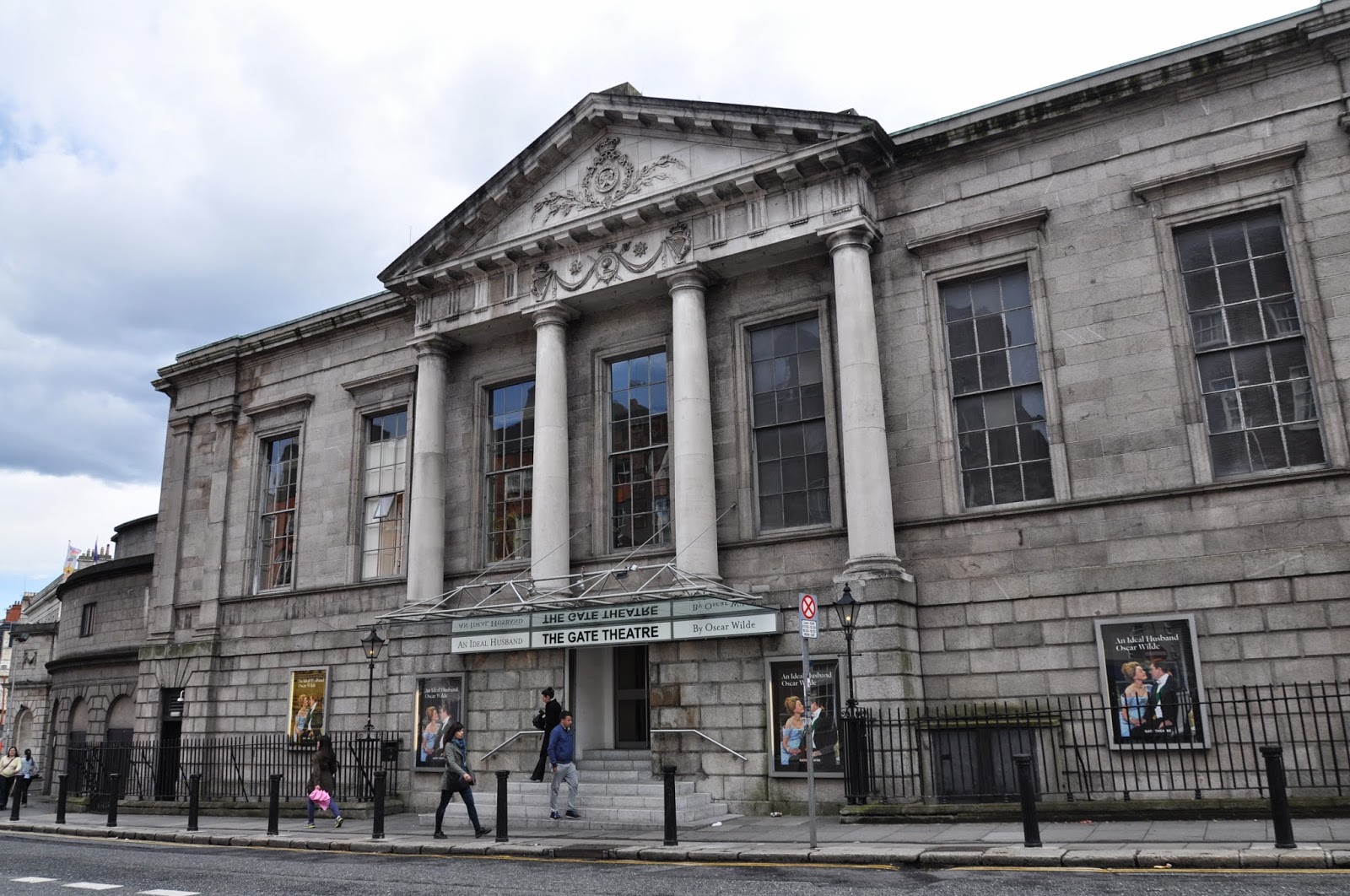
We walked into North Earl on our right until we stumbled onto the imposing statue of James Joyce just before stepping into O'Connel street. Across the street we could see two rather outstanding buildings, one being the General Post office with its incredibly beautiful Greek-style portico and the other one the 1784 Gate Theatre.


James Joyce's statue on North Earl street.


It was quite warm, this possibly being the reason as to why there were still many people strolling up and down the avenue. We decided to walk up along O'Connel with the Presbyterian Abbey undergoing renovation works on the left and a little bit further the Garden of Remembrance.


Having been dedicated to those who fought for freedom and fell in the insurrection of 1916 this garden's design is said to be intimately tied to Irish legends. In spite of being closed we still managed to identify and photograph one statue representing the children of Lir  in the process of being metamorphosed into swans for a period of 900 years.


As we walked back down the O'Connel Avenue I decided to photograph the overall view with its statues. I particularly like the one of James Larkin (seen from the back). Larkin is said to have been one of most active Irish trade Union leaders, whose well known phrase " The great appear to be great because we are on our knees. Let us rise" inspired many to fight for their own rights.


Upon reaching the O'Connel bridge we looked down and noticed a metal plaque with a James Joyce Ulyses' extract written on and that was precisely the last image I captured before heading back to the guest-house with a Thai take away meal, which we seem to have gobbled down in minutes, not because we were hungry but because it was really tasty.


Sunday, 8 June 2014

The Capital of Karl Marx staged by Silvain Creuzevault at Culturgest, Lisbon - The 7th of June 2014


I must confess I hesitated a while prior to having decided to go and watch Silvain Creuzevault's staging of the Capital by Karl Marx, not only because I felt the two hours and a half performance would be fairly hard to withstand but particularly because I believed it would almost naturally bring about rather unpleasant reminiscences of the way this particular text was "taught" (or rather, forced upon us) at school when I was an adolescent.


The performance captivated me right from the beginning though, as a single actor on stage voiced  a Bertold Brecht, Sigmund Freud and Michel Foucault  inter active dialogue in what I would definitely consider one of the best performing acts I have ever seen on stage. Arthur Igual (I believe this to be the actor's name) brilliantly incarnated discourses and concepts that set the scenario before the sequencing that would take the spectators into the 1848 Revolution, the Club des amis launched by Francois-Vincent Raspail and inflamed dialogues that revolved around and had us plunged into intellectual stimulating political issues that do concern us all.


Ironic, rich and rather profound dialogues between Armand Barbés,  Louis-Auguste Blanqui, Louis Blanc, Engels and Albert, the worker (Alexandre Martin) further immersed the audience in the problematic issue being brought out and despite there being too much information to "digest" it still had us ponder.


I would like to praise the amazing ensemble of  male actors, whose performance was at the heart of the success of this theatrical piece, in my most humble opinion. I was particularly impressed by Antoine Cegarra, Pierre Devérines, Bénoit Carré, Vincent Arot and Lionel Dray, not forgetting the outstanding Arthur Igual. But my special thanks should be addressed to Silvain Creuzevault for having staged it the way he did.


Actors: Vincent Arot, Bénoit Carré, Antoine Cegarra, Pierre Devérines, Lionel Dray, Arthur Igual Clémence Jeanguillaume, Léo-Antonin Lutinier, Fréderic Noaille, Amandine Pudlo, Sylvain Sounier, Julien Villa, Noémie Zurtelli
Lighting: Vyara Stefanova and Nathalie Perrier
Production: Elodie Régibier, Le Singe
Co-Production: Nouveau Théatre d'Angers, Centre Dramatique National Pays de la Loire, La Coline - Théatre National, Comédie de Valence, Festival d'Automne à Paris, Centre Dramatique National Drôme Ardèche, La Criée- Théatre National de Marseille, Le Parvis - scène nationale Tarbes Pyrénées, Printemps des comédiens, MC2: Grenoble, La Filature - scène nationale de Mulhouse, L'Archipel - scène nationale de Perpignan, Théatre National de Bruxelles, Le Cratère - scène nationale d'Alès, Scènes Croisées de Lozère, GREC 2014 Festival de Barcelona, TnBA - Théatre de Bordeaux à l'Aquitaine, Kunstenfestivaldesarts, NXTSTP.
Participation: Théatre Garonne and Théatre Nacioanl de Toulouse
Support: General Dictorate of Artistic Creation of the Ministry of Culture and Communication, Institut Français du Portugal and the French Embassy in Lisbon.


Friday, 6 June 2014

Perhaps all the dragons ... by Berlin, Teatro São Luis, Lisbon - The 5th of June 2014


I was feeling rather tired yesterday and therefore sometime in the afternoon wondered whether I should go to the Theatre in the evening as I had initially programmed or allow one of my daughter's friends to go instead of me.


I am particularly happy I ended up going because Perhaps all the Dragons was really worth the effort on my part as it did exceed any of my expectations and had me ponder on extracts of the five monologues I "listened to" as part of the ongoing performing act.


The audience was invited to sit anywhere around a huge table comprising thirty numbered seats set in front of screens and listen to thirty different stories being in the form of  "interactive" monologues. At the end of each story the spectator was told to follow a written instruction and further move along the round table (assigned seats as in accordance to those written on a card inside an envelope).


The narratives (five per spectator) despite being  filmed monologues were "interactive" in the sense that they were one to one, eye in the eye "encounters" and despite there being a screen it was as if the person on it was directly addressing you and from time to time aware of what was going on in the room, whenever there was any interference or background noise that led us all to look in that particular direction.


The first of "my" stories (29 true stories out of the total 30) was scientifically oriented whilst the second and fifth ones were rather emotional and within the realm of ones' life contradictions and fears, with the third being tied to emotions on a bullfighting ring and the fourth on the six degrees of separation  philosophical claim that any living soul is connected to anyone else through six or eventually fewer links.  


My "interlocutors" were from different continents and some of them from countries as culturally diverse as Israel and Japan. I ended up learning that in Japan some 700,000 people, representing 1% of the Japanese population live like "hikikomory" (a word that stands for social outcasts), cut off from any social life for a minimum average of 5 to 10 years ... I learned that one can simultaneously be a "killer" and a "saviour" ... I got to learn quite a few things ... but the number of things I learned compared to the number of questions that have surfaced since then is minimal ... 


Perhaps all the dragons .... "Perhaps all the dragons in our lives are princesses who are only waiting to see us act, just once with beauty and courage. Perhaps everything that frightens us is in its deepest essence, something helpless that wants our love." - Rainer Marie Rilke


Concept: Berlin (Bart Baele and Yves Degryse)
Soundtrack and mixing: Peter Van Laerhoven
Text: Kirsten Rosendaal, Bart Baele and Yves Degryse
Production: Berlin
Co-Production: Deutsches Schauspielhaus, Hamburg; KunstfestivaldesArts, Brussels; Le CENTQUATRE, Paris; Dublin Theatre Festival; Le Festival in Groningen; La Bâtie Festival de Genève; ONDA in Berlin.
Support: Flemish Government and the Cultural Programme of the European Union.


Tuesday, 3 June 2014

Bonds ...


I do almost inevitably establish some sort of strong bond with the students I have to work with,  in which I quite often assume a mother-like type of role in as much as the way I help them overcome the difficulties they have to go through in order to achieve the required aeronautical Language skills.

And if I say mother-like attitude it is because there is a rather unique commitment similar to the one mothers have in regards to their children, based on unconditional giving associated to an ongoing worry as they  make their way through the numerous obstacles throughout the course, which may highly depend on the sharing of one's personal experience. 


Miguel, José, Vanessa, Lena, André and Tomás (from left to right).


Whenever I travel I do also inevitable establish bonds with the people I end up getting aquainted with and whom I share a daily contact with during the course of the organised circuits. And if it is true that many of the people I meet will be mere trip companions I will not get to see again, some do come across as people I know I will further develop or want to develop a bond with.


Just three weeks into the latest long trip to Armenia I met two of my "Armenian" trip colleagues Annick and Claude in Lisbon, whom I spent a very interesting evening with at the Alfama house they rented for their one week holiday in my hometown. A reinforced bond and one I feel will further continue.