Monday, 12 May 2014

The House of the Mosque by Kader Abdolah ...


I have just finished reading a book I really enjoyed, whose Iranian writer I had never heard of, though  he has already been praised as a writer.
 
Primarily exploring how a privileged Iranian family coped during the 1971 Islamic Revolution the House of the Mosque is a sequence of intelligent dialogues which bear symbolism, and a parade of very interesting characters, who contribute towards this intricately beautiful novel.
 
Its auhor, whose nom de plume is Kader Abdolah, has been compared to Nabokov and Conrad in his mastery of alien literary language. His writting is interspersed with surahs of the Qur'an, but I don't think they have been much of a "burden" as their context is relevant and they enlighten one's view point on the Islamic religion and Iran. 


"I just simply have to say I think it is a masterpiece of our times. I admit I was sceptical and yet just fell into it, was carried away by it and couldn't put it down."


"Before I began reading it I thought, or at least hoped, that it was going to be something a bit special. But I didn't realise then just how special it would turn out to be. I said in my forethoughts that the book offered a real prospect of a culturally rich reading experience, and its author certainly delivers on that score."


"It's only very occasionally that a book comes along that touches me so deeply and so profoundly that I remember it for always. The House of the Mosque is one such book and I wholeheartedly recommend that everyone read it. If that's not convincing enough on its own than bear this in mind - it's rare enough for me to award a full five stars for any book there is, but for this one I was desperately seeking out a six."


"A sweeping, compelling story which brings to life the Iranian Revolution, from an author who experienced it first-hand."


I can't help looking forward to buying Abdolah's first book translated into English (My father's notebook) and his most recent one (The Prince).


Sunday, 11 May 2014

Opéra Opaque by Plaxus Polaire under the direction of Yngvild Aspeli at Museu da Marioneta, Lisbon - The 11th of May 2014


The main reason for having decided to go to Opéra Opaque was the name of one of the puppeeters - Polina Borisova, whose solo performance on Go I had seen last year and absolutely fell for. Despite it not being her production this time I nevertheless considered that it had to be good, simply because I couldn't imagine this amazing actress and puppeteer participating in something which wouldn't be challenging and I was right.

She was joined by another very talented puppeteer, Pierre Tual and I feel that the whole performance greatly depended on their mastery.


The life-size puppet, Madame Silva whose peculiar and macabre inner premonitions  we were exposed to in the form a shadow images projected within a moon-like screen is said to have come a lost village in Siberia, though ancient rumours mention her name as being associated with an abandoned castle in Brittany or the Norwegian forests, though one thing seems to be certain, she has connections to the hereafter.


The story unfolded in such a natural way that we seemed to anticipate Madame Silva's reactions in no time and yet despite her natural like attitudes that mostly made us laugh, there were times in which the unexpected played an important role and we either felt like screaming or had chills going down our spine.


The puppets built by Polina Borisova, Yngvild Aspeli and Priscille Du Manoir  were so exquisitely peculiar that throughout the performance they could easily assume a role of absolute duality and be convincing.


The shadow performing scenes which were equally mastered added to the mysterious fantasy peopled by characters and animals that brought into the play the necessary suspense.


Integrated in the FIMFA 2014 Lisbon (International Festival of Puppets and Animated forms) Opéra Opaque was beyond no doubt one of its highly praised performances.


Direction: Yngvild Aspeli
Actors/puppeteers: Polina Borisova and Pierre Tual
Sound design: Guro Skumsnes Moe
Stage design: Gunhild Mathea Olaussen
Puppets's construction: Yngvild Aspeli, Polina Borisova and Priscille Du Manoir
Lighting design: David Farine
Costumes: Sylvia Denais
Produced in co-operation: Compagnie Philippe Genty - France
Co-production: Teater Innlandet - Norway; La MCNN Centre de Création et de Production - France
Supported by: Direction des Affaires Culturelles - DRAC Bourgogne - France; Norsk Kulturrad- Norway; Hedmark Fylkeskommune - Norway; Spenn.no - Norway; Fond for Lyd og Bilde - Norway; Fond for Utovende Kunstnere - Norway
In collaboration with: Turnéorganisasjon for Hedmark - Norway
Photos: Kristin Bengston Hagen
Technique: Full-view manipulation and shadows
Duration: 45 minutes
Language: Without words


Saturday, 10 May 2014

The latest film I have seen ...


I have been to see a film, which I consider to have been one of the best films I have seen lately. An apparently banal story turned into a gem, which has won the Critics Week Viewers choice award and world wide praise, the Lunchbox is a 2013 Indian epistolary-like film, in which an unexpected mix-up on the part of the Mumbai dabbawalas (lunch delivery men) ends up having a lunchbox delivered to the wrong person.


"It is as much a moving film and muted love story as it is an evocative portrayal of loneliness."


"It is pretty much what stays in the mind at the end of a memorable set of Jazzmen - not their lapses but the heights they scale."


"It is ultimately less about love than about the vulnerability relationships place us in emotionally, and the courage required to move past pain, and experience life again after we've been hurt."


"One thing that makes the Lunchbox so strong is that a touch of melancholy hangs over its sweetness. Finally, this is a film about the wheel of life, about what helps us cope with its turns and find our way in its unforgiving labyrinth."


An absolute must.


Friday, 9 May 2014

Friends ... occasional friends and memories ... - Paris and Lisbon - The 24th and 25th of April 2014


Occasional friends may play an important role in one's life ...  and the fact that I headed to my friends' near Gare du Nord, soon after having landed at Charles de Gaulle and even prior to checking in at the hotel I'd be spending the night at before flying back to Lisbon speaks for itself.


We got to know each other during a circuit in Uzbekistan the previous year and have since then further developed the bond we created as trip companions. I spent a rather interesting afternoon with Danielle and Gerard in which I partly forgot my tiredness. Daniele's veranda garden overlooks Sacré Coeur, one of my favourite spots in France ... one that will forever be tied to some of my fondest memories of the past.


I was so tired by the time I got back to the hotel that I went to sleep almost immediately without even having had dinner. The next two days would be quite tiring and such a good night's sleep eased a bit the anxiety of having to take a bus from Paris Charles de Gaulle to Paris Orly ... to board a flight back to Lisbon ... to get things organised at home just in readiness for the following day's travel diary course and a cultural visit in which I'd be acting as a guide for the daughter of Jean Jacques, another occasional acquaintance I developed a bond with when I travelled to Rajastan, who just happened to be spending some days in Lisbon with her husband.


Elvire and Michel spent the whole afternoon with me and despite having been just a simple Lisbon touring afternoon that had me revisit the Museum of Azulejo it brought back memories of a past.


The richness of those we meet along the way can only be compared to Art ... it will never be if we don't allow ourselves to get to know it ... even if it's fleeting ...


Discovering Armenia 9 day circuit - Day 8 (evening) and day 9 (early morning) - Traditional evening dinner and Zvartnots airport - The 23rd and 24th of April 2014


As we got back to the hotel and prior to getting my luggage ready so as to embark on the early morning flight to Paris I decided to take one last photograph from my hotel room window.
We were soon driven through the city to a local restaurant where a folk dinner was going to be held in our honour.


The restaurant was very well decorated ... the food we were presented with was very tasty ... the musicians who played for us all throughout the dinner were really good, (despite the fact that I personally felt the sound produced by the duduk and the voice of the singer gave it a distinct longing tone, which could have had us all cry for no apparent reason) ... and yet the overall atmosphere was not the "happiest" one we had had ... there was a clear farewel type of approach to the evening that didn't allow us to express the joy of being together for (presumably) the last time ... at least in Armenian territory ...


Walking the streets of Yerevan that evening, the eve of the Genocide Memorial day, was quite an experience. Young people with lit candles could be seen walking towards the independence Square in groups ... they were well over the hundreds ... everywhere ... and according to what we were told by Arnine .... would be spending the night awake ... out in the streets. 


... Light ... there was light in the darkness of the night ... the street lamps ... the lit town hall ... the "lit" minds ...


This short "discovery" trip in Armenia made me admire its people ... more than I already admired them ... and the following morning ...  soon after having left the hotel and as we stood at Zvartnots airport awaiting to board the Air France flight I looked out and as I admired the Ararat Mountain from the waiting lounge felt a sense of peacefulness taking over me ...


Discovering Armenia 9 day circuit - Day 8 (afternon cont.) - Geghard Monastery - The 23rd of April 2014


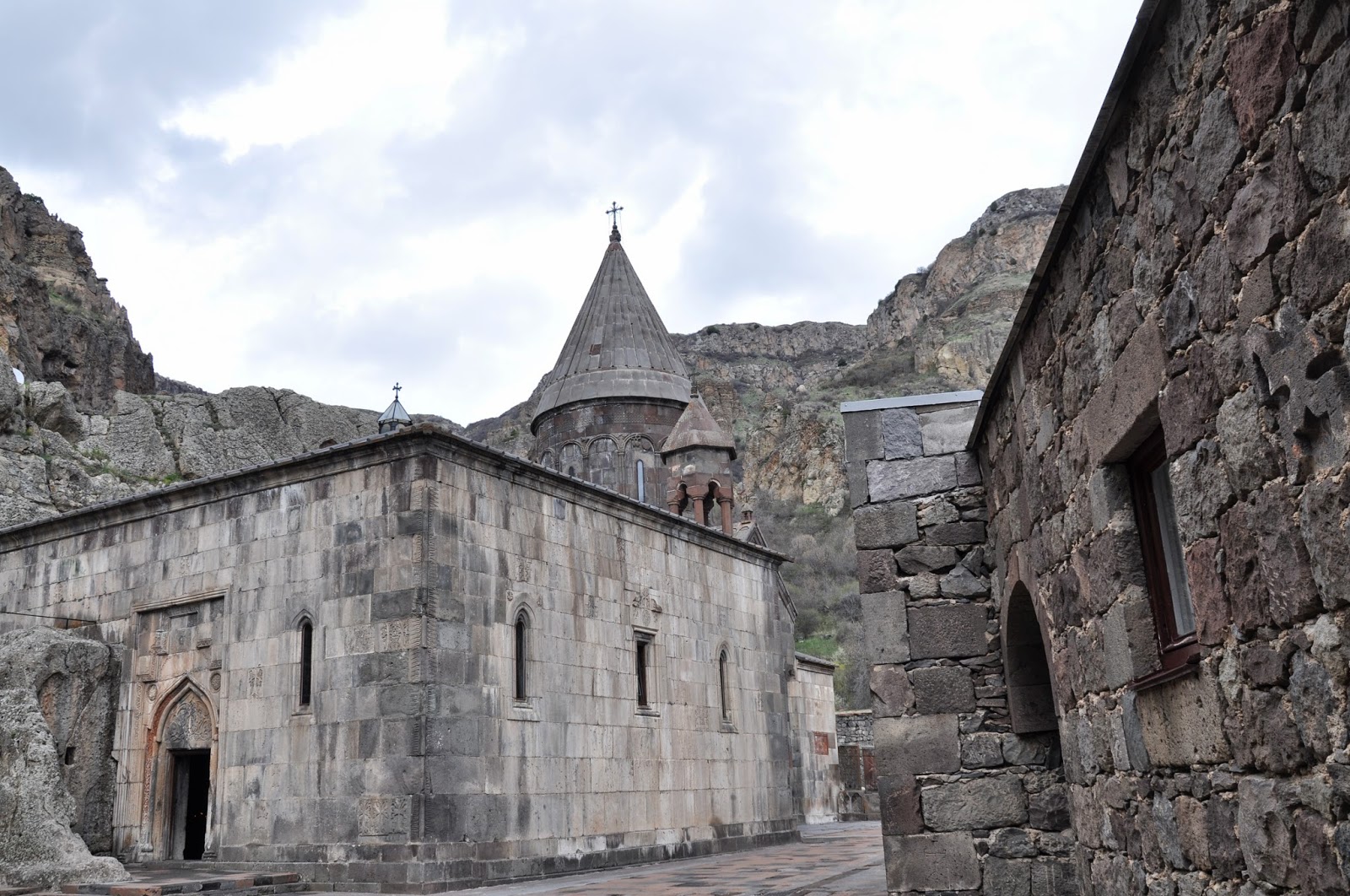
Our last visit of the day, which would also be the last visit of the Armenian circuit was to the Geghard Monastery, listed as a UNESCO World Heritage Site.


The spectacular towering cliffs surrounding the Monastery, which we photographed from a distance, are part of the Azat river gorge and have been included together with the Monastery in the World Heritage Site listing.

Its name, Monastery of the Spear is said to have originated from the spear which pierced Christ at the calvary and was allegedly brought to Armenia by Apostle Jude and later stored amongst many other relics.


Nothing remains of a 4th century Monastery built here and the revival of the Monastery building only occured in 1215, though there are some inscriptions dating to 1160 just above the gateway to the Monastery complex.

There are more than 20 rock-hewn chapels and service premises surrounding the main site, many of which with carvings.


The main buildings of the Monastery are surrounde by walls on three sides and a cliff face on the other. its construction is said to have been started by the Zacharian family who came into possession of it after the dfeat of the Seljuks.
 
 
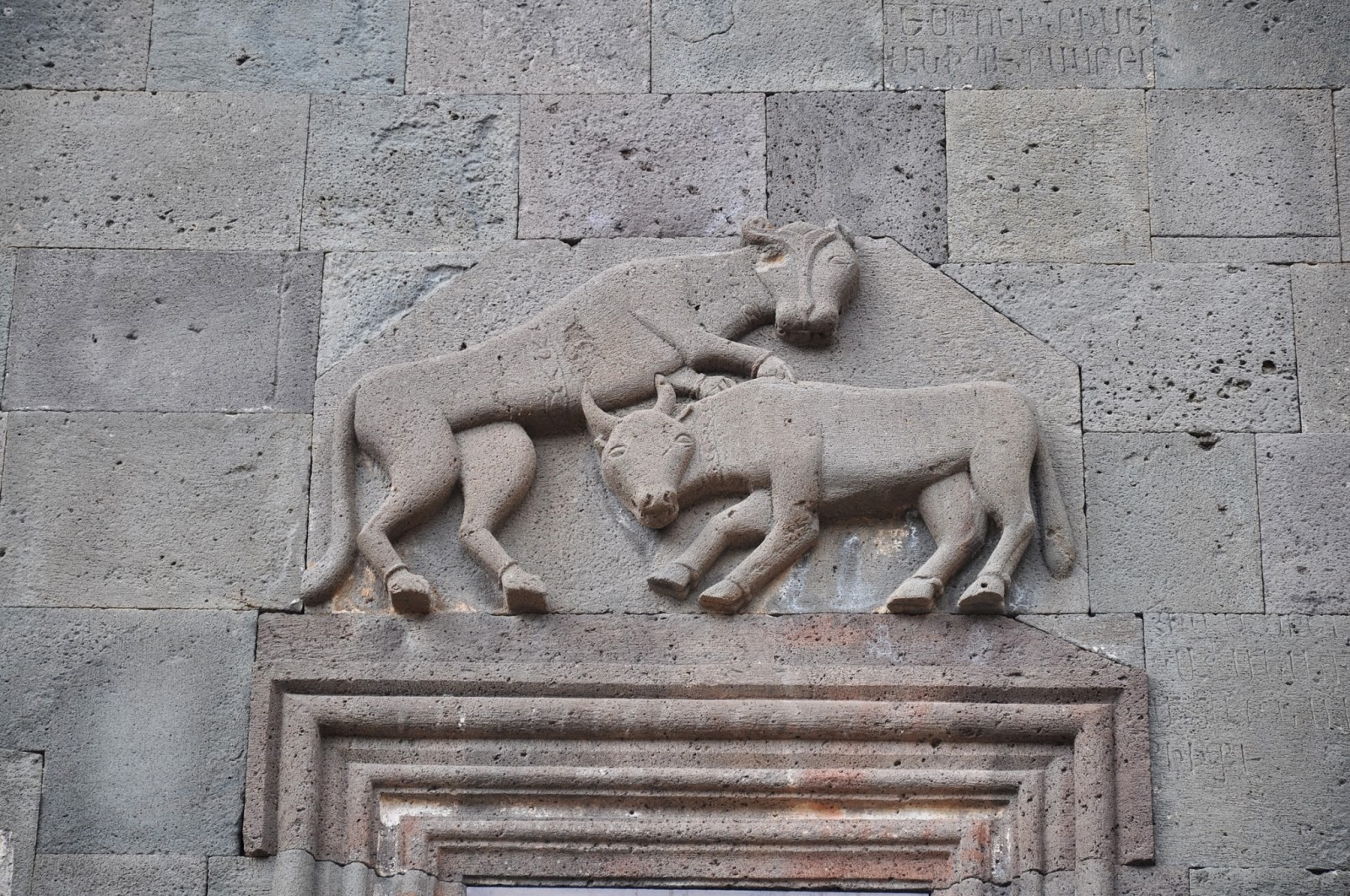
The main Cathedral built in 1215 is a cross dome one, with thecircular tambour decorated with graceful arcature.On the portals and cornices there are a few birds and animals, as well as floral and geometrical patterns.The gavit on the west side is attached to the rock face and its tympanum has an interestingly beautiful floral design aithin the ogee arch.


On the north wall of the Prosh family Mausoleum above the archways one could see a relief carving of a goat with a ring in its mouth to which is attached a rope whose two ends are round the necks of two lions which are looking outwards.The ends of the lions' tails are are dragons looking upwards. Below it an eagle with spreading wings grasps a lamb in its talons.


To the right of the entrance two sirens, mythical creatures with the crowned heads of women and the body of birds. These creatures said to have lived on rocky islets are said to have lured men to their death, either by enchanting them with their singing so that they were shipwrecked or in other versions having them fall asleep with their singing so that they could kill them in their sleep.


The gavit which formed the burial vault of Prince Papak Prosh and his wife is accessed by a narrow subterranean passage decorated with khachkars carved into the rock, which are quite impressive.


We strolled around for a while so as to take some pictures before heading back to Yerevan for what would turn out to be the farewell dinner.
 
As we looked at the surrounding view we, I believe, felt a touch of sadness for we would soon be leaving this country and would in one way or another remember it in the days to come.