Saturday, 20 April 2013

Marc Chagall's exhibition at Musée du Luxembourg, Paris - The 17th of April 2013


Marc Chagall's exhibition "Une vie entre guerre et paix" in Paris couldn't possibly have been carried out at a more appropriate time, once I have been sent there on a conference and had the unique opportunity to see it.

As soon as I left Orly airport I headed to the Saint Sulpice area, where the Luxembourg Museum is located, in what looked like a perfect Spring day to be immersed into those strong colours and fairly-like paintings, whose images had always caught my attention.


I had to queue for about half an hour before being allowed into the exhibition, which I felt was to be expected, despite the early hour, but once I walked in and grabbed an audio-guide, so as to better understand some of his paintings, the tiredness and degree of anxiety were "vanished".

Having lived through the twentieth century, experienced a revolution, two major wars and an exile period has provided Chagall with a rather exceptional perspective, which influenced his artistic approach, notably in this particular exhibition  assembling around a hundred paintings and sketches, seems to highlight his home town Vitebsk, the Hasidic Jewish tradition, the Bible, the family, the couple and the circus.

I was impressed with the number of times his wife Bela was portrayed, clearly showing a strong marital bond and amorous feeling on their part.

It wasn't but half way through the exhibition that I realised photos of most paintings could be taken, though the increasing number of visitors didn't allow me to go back and photograph many of the ones I had just seen.


Songe d'une nuit d'été, 1939


La Cruxification en jaune, 1942 (left). La guerre, 1943 (right).


Résistence, 1937-1948 (left). Libération, 1937-1952 (right).


Autour d'elle, 1945


A ma femme, 1933-1944


Le paysage bleu, 1949


Monde rouge et noir (details) - 1951


Le Roi David (detail) - 1951


La danse, 1950 -1952


I was absolutely mesmerised ... and there are really no words to express what I really felt throughout the whole exhibition, which I wouldn't mind going back to any other given time. It may be about individual feelings, more than the impact the themes and the vibrant colours have on us as visitors, but the truth is I feel it might be almost impossible not to be touched by the beauty and "strength" these paintings convey.


I must say the three hour visit was really worth it ...


Wednesday, 10 April 2013

The Invention of Solitude - The Portrait of an Invisible Man - by Paul Auster ...


As I finished reading the first part of the Invention of Solitude - The Portrait of an Invisible Man, I felt the father figure being described had quite a few characteristics in common with somebody who played a fairly similar role in my life, though at a companionship's level and in spite of not having altered any of my disappointment feelings regarding the situation it did make me aware of the clear fact that some people are "not cut out to" play certain roles in life (which had not occurred to me) and more so in the justification for it - the simple fact they "have no talent" for such roles.


"For a man who finds life tolerable only by staying on the surface of himself, it is natural to be satisfied with offering no more than his surface to others. There are few demands to be met, and no commitment is required. Marriage, on the other hand, closes the door. Your existence is confined to  a narrow space in which you are constantly forced to reveal yourself - and  therefore, constantly obliged to look into yourself, to examine your own depths."


"Solitary. But not in the sense of being alone. Not solitary in the way Thoreau was, for example, exiling himself in order to find out where he was; not solitary in the way Jonah was, praying for deliverance in the belly of the whale. Solitary in the sense of retreat. In the sense of not having to see himself, of not having to see himself being seen by anyone else."


Monday, 8 April 2013

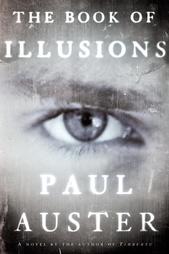
The book of illusions by Paul Auster ...


The more I read Paul Auster's books the more they challenge  my thoughts and even my emotions. The book of illusions is such a book "the unswerving compulsion to unearth, and ultimately understand another person's identity" the main theme according to the critic Mark Thalaite, in "a compelling literary mystery story, but also a complex and genuinely moving meditation on the nature of identity and how any attempt to live vicariously through another's life will always be doomed to failure".


I haven't resisted taking down some  of its quotes, though I could fill in endless pages with many more.


"We all want to believe in impossible things, I suppose, to persuade ourselves that miracles can happen."

"What matters is not how well you can avoid trouble, but how you cope with trouble when it comes."

"There was nothing to see, nothing to distract me from succumbing to my fears, and the longer I kept my eyes shut, the more terribly I saw my fears wanted me to see."


An absolute "must" as far as book reading is concerned.


Montserrat, The Monastery and Basilica - The 21st of June 2006


The fact that the hill of Montserrat is situated just 38 kilometres from Barcelona and its legends have very often charmed people led us to take a train and then walk up all the way to its Monastery and Basilica.

Clearly impressive, no matter which way we looked at it ... whether it was the surrounding atmosphere that provided the grandeur or the "simplicity" of the huge complex ...


The present community of Montserrat is said to be made up of over seventy Benedictine monks, whose motto "Ora et Labora" still sets the rhythm of their daily monastic life.


The eighteenth century atrium that provided access to the church had a series of sculptures of Saints and Kings connected with Montserrat.


The image of Our Lady of Montserrat, popularly referred to as La Morenetta (The dark one) is a 12th century Romanesque polychrome carving enthroned in a silver altwrpiece installed in the upper section of the Basilica apse.

I still remember the solemnity with which  we walked up the mosaic-decorated stairway and then along the antechambers so as to touch her figure, which stood there stretching out the right hand in which she held a globe, symbolising the Cosmos and her left hand resting on her child's shoulder indicating he is her son, the omnipresent King, whose right hand gives a blessing, whilst the left hand holds a pinecone, symbol of fertility and everlasting life.

We had to stand in a queue of  quite a few dozens of worshippers ..., whose devotion to the Lady was noticeable in the way they approached her and seemed not to let go of her.


We then made the way of the cross  stopping at the 14 stations leading to the Holy Cave with its small chapel embedded in the rock, though we naturally made it not in the pilgrimage spirit which must characterise such a path ...


... I did pray, as if I had stepped back into my religious-oriented childhood ... the bareness of such a place impacted me ... and I did (do) feel we are nothing if not for a few convictions ...


Note: Photos taken by C.

Friday, 5 April 2013

Gaudi's Barcelona revisited ... or a sequence of details ... (The 20th of June 2006)


There aren't too many things I regret having done in my life so far ... though some I might have possibly done in a slightly different way, should I be given the the opportunity to live through them again ...

And yet I have had a strong feeling of regret in regards to having gone to Barcelona in 2006 and not having taken that period of time to travel with both my children to Prague.

Had I known I wouldn't be given that chance again I would not have hesitated ... and although death is unpredictable (Faye would be "gone" less than a month and a half later) ... I still feel a rather strong guilt complex.

Prior to that I had already been to Barcelona several times and it was more the willingness to share such an interesting city and particularly Gaudi with a very special person that led me there once more ... 

I haven't looked at those photos ever since and if I have done it now is simply to exorcise some of my fears by looking at things that bring out hidden feelings of happiness and sadness simultaneously ...


Sagrada Familia church was naturally the first place  I revisited. Its façades impacted me once more ... how couldn't they? The Nativity façade   constructed between 1894 and 1930 is decorated with scenes dedicated to the birth of Jesus, whilst the Passion façade (work of Josep Maria Subirachs initiated in 1954) has striking sculpted images of the Last Supper, Ecce Homo and the three Marys among the many  other angular-like sculptures symbolic of the drama involving the death of Christ and its surrounding circumstances.


Details of the Passion façade


Details of the Nativity façade


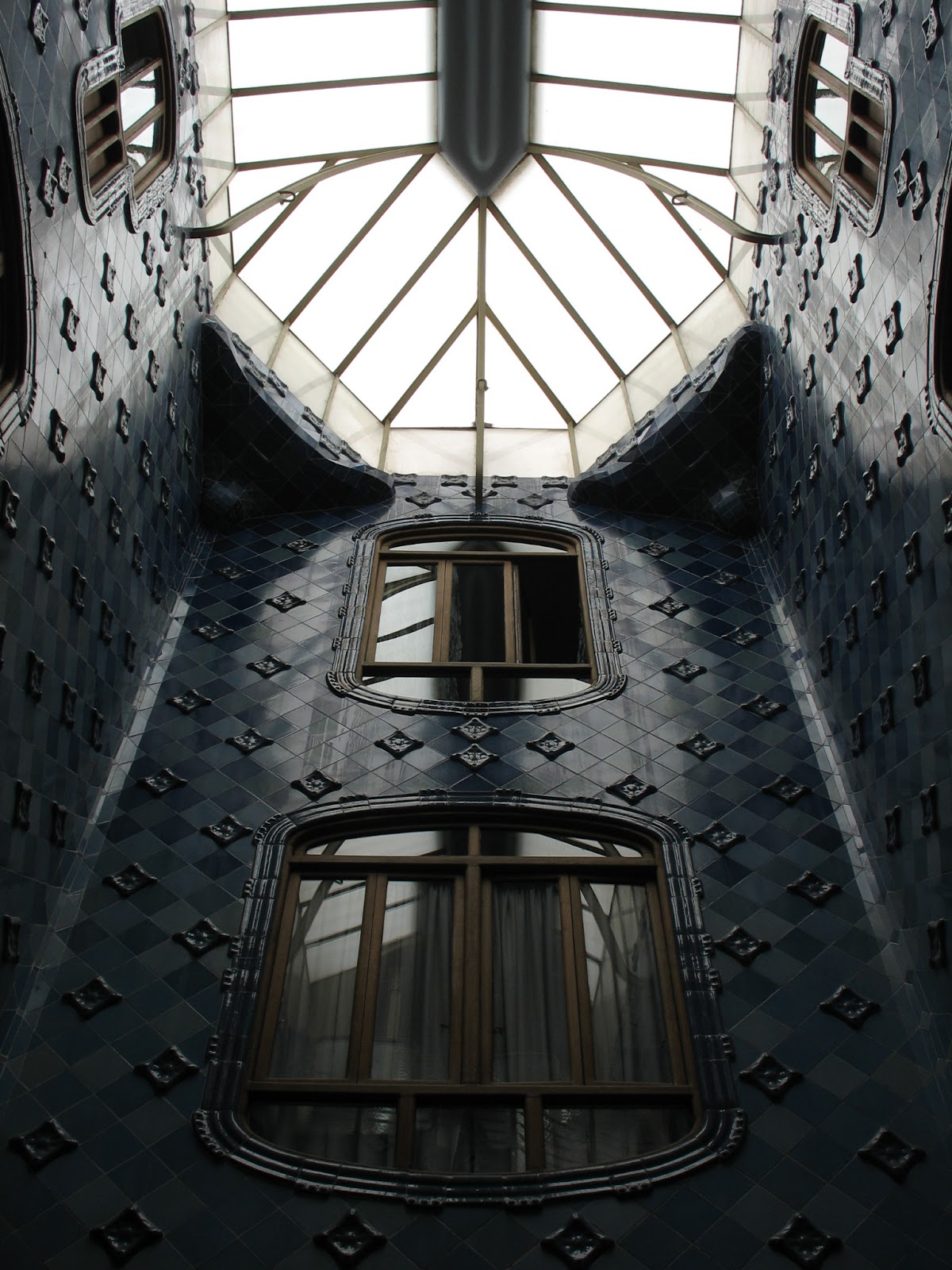
We then visited Casa Batlo, one of Gaudi's masterpieces ...


... followed by Casa Mila, la Pedrera ...


Details is what I mostly remember ... similarly to what life seems to be about ... a sequence of details ...


Note: Photos taken by C.